-
Lung volume values will vary according to gender, age, height, health, and physical fitness. Performing this activity will help you to understand how the various lung volumes are interrelated and how lung volumes change in size during exercise. This activity also illustrates the constant sizes of different lung capacities, even though the various lung volumes that are contained within them are altered with exercise.
Objectives
- Measure respiratory volumes at rest and after exercise of subjects in good health.
- Calculate respiratory capacities using the measured respiratory volumes.
- Calculate minute ventilation (minute respiratory volume).
- Observe how exercise affects respiratory volumes and capacities.
-
Review
Play the animation to review respiratory function.
After you have completed this section, click on the Pre-Lab Quiz button at the top menu bar to assess your understanding.
Air enters and leaves our lungs with each breath. Resting adults inhale and exhale 500 mL of air on average with each breath (tidal volume, TV) and breathe about 12 times per minute (breathing rate, BR).
The product of tidal volume and breathing rate indicates the amount of air that moves into and out of the lungs each minute (minute ventilation, MV = TV × BR). Minute ventilation increases when the body is using more oxygen and producing more carbon dioxide, as occurs in exercising.
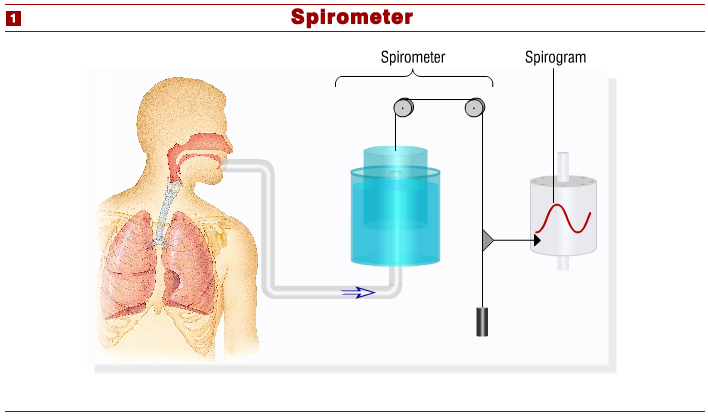
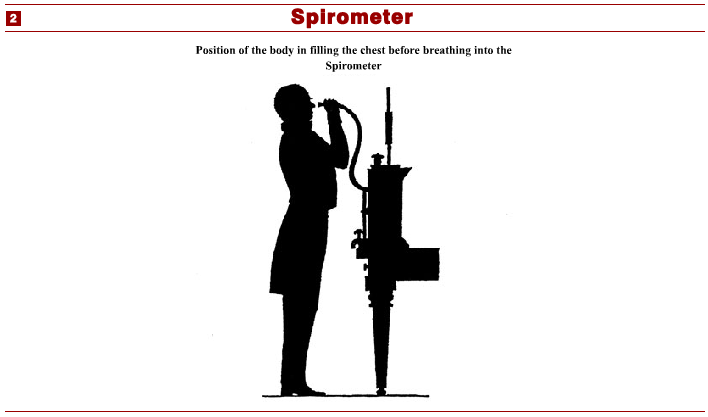
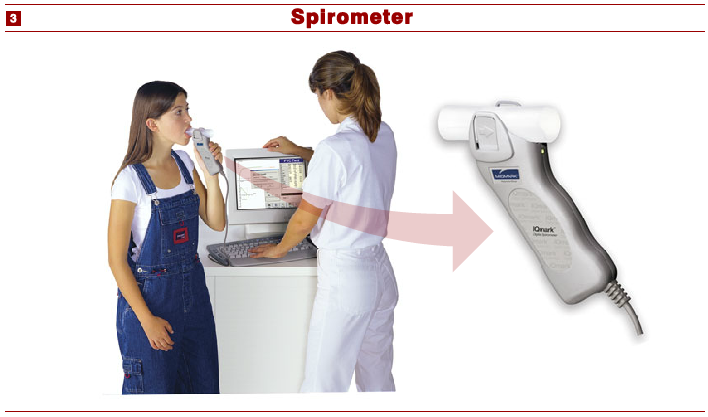
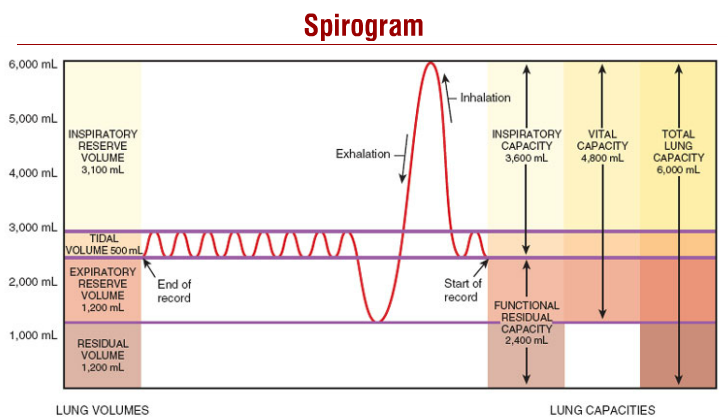
A spirometer is an instrument used to measure lung volumes and capacities. The record resulting from the tests is called a spirogram. The spirometer used in this experiment measures both inspiratory and expiratory volumes.
Lung Volumes of a Healthy Adult
- Tidal Volume (TV) — Tidal volume is the amount of air inhaled or exhaled in one breath. Resting tidal volume is normally about 500 milliliters.
- Inspiratory reserve volume (IRV) — Volume of air that can be forcibly inhaled after normal, quiet inhalation (about 3100 mL or 3.1L)
- Expiratory reserve volume (ERV) — Volume of air that can be forcibly exhaled after normal, quiet exhalation (about 1200mL or 1.2L)
- Residual volume (RV) — Volume of air that remains in the lungs after a maximal exhalation (about 1200mL or 1.2L)
Lung Capacities of a Healthy Adult
Lung capacities can be calculated by adding two or more lung volumes.
- Inspiratory capacity (IC) = TV + IRV = about 3600 mL or 3.6L
- Functional residual capacity (FRC) = ERV + RV = about 2400 mL or 2.4L
- Vital capacity (VC) = TV + IRV + ERV = about 4800mL or 4.8L
- Total lung capacity (TLC) = TV + IRV + ERV + RV = about 6000 mL or 6L