Laboratory Report
Predictions
Materials and Methods
- Which respiratory volume was calculated?
- What was the purpose of the nose clip?
Results
| Resting Values | Exercising Values | |||||||||
|---|---|---|---|---|---|---|---|---|---|---|
| Breathing Rate | TV(L) | ERV(L) | IRV(L) | RV(L) | Breathing Rate | TV(L) | ERV(L) | IRV(L) | RV(L) | |
| Subject 1 | ||||||||||
| Subject 2 | ||||||||||
| Subject 3 | ||||||||||
| Average | ||||||||||
Comparison of Resting and Exercising Lung Volumes and Breathing Rate
- Did the breathing rate increase, decrease, or not change with exercise?
- Did the tidal volume increase, decrease, or not change with exercise?
- Did the expiratory reserve volume increase, decrease, or not change with exercise?
- Did the inspiratory reserve volume increase, decrease, or not change with exercise?
- Did the inspiratory capacity increase, decrease, or not change with exercise?
- Did the functional residual capacity increase, decrease, or not change with exercise?
- Did the minute ventilation increase, decrease, or not change with exercise?
| Resting Values | Exercising Values | |||||||||
|---|---|---|---|---|---|---|---|---|---|---|
| IC(L) | FRC(L) | VC(L) | TLC(L) | Minute Ventilation (L) | IC(L) | FRC(L) | VC(L) | TLC(L) | Minute Ventilation (L) | |
| Subject 1 | ||||||||||
| Subject 2 | ||||||||||
| Subject 3 | ||||||||||
| Average | ||||||||||
Comparison of Resting and Exercising Lung Capacities and Minute Ventilation
Discussion
Lung Volumes and Capacities
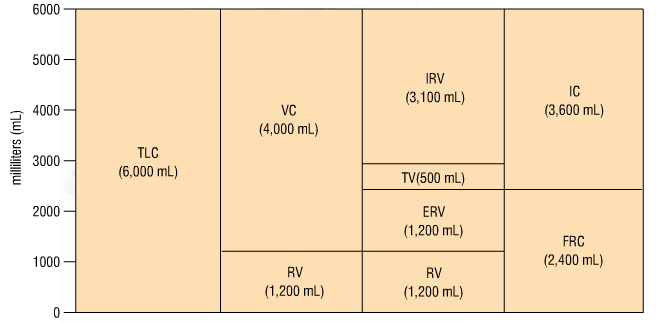
- Explain the change in ERV with exercise.
- Explain the change in IRV with exercise.
- Explain the change in IC with exercise.
- Explain the change in FRC with exercise.
- Explain why RV does not change with exercise.
- Explain why VC does not change with exercise.
- Explain why TLC does not change with exercise.
- During exercise, the depth of respiration increases. Name the muscles involved in increasing the depth of respiration and explain how muscle contraction causes this increase.
- Explain the importance of the change in minute ventilation with exercise.
- Restate your predictions that were correct and give data from your experiment that support them. Restate your predictions that were not correct and correct them with supporting data from your experiment.
Application
- During strenuous exercise, TV plateaus at about 60% of VC but minute ventilation continues to increase. Explain how that would occur.
- Emphysema causes alveolar dilation and destruction of alveolar walls which causes an increase in residual volume with air that cannot be exhaled. Assuming that an individual's TLC does not change, explain why a person with developing emphysema is not short of breath while resting, but becomes short of breath after climbing a flight of stairs.
Click or tap the Save button to save your lab report.
Click or tap the PDF button if you wish to create a version that can be emailed.
Save the PDF by using the save feature of your web browser.
Your data for the entire module, including the Laboratory Report, will be deleted.
Data Collection will refresh with a new data set.
Press Escape button for close