-
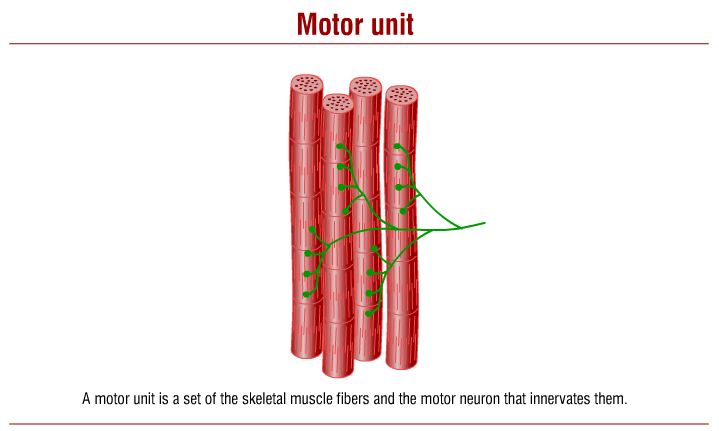
A motor unit consists of a motor neuron and the muscle fibers it innervates.The maximum force of contraction (tension) that a skeletal muscle motor unit develops is dependent on sarcomere length, the stimulation frequency (action potential frequency along the motor neuron), motor unit size (number of muscle fibers within a motor unit), and the availability of nutrients and oxygen.
Objectives
- Measure the minimal voltage required to stimulate a motor unit and describe how increasing the stimulus voltage affects muscle contraction.
- Discuss how muscle fiber length affects the contraction force of a motor unit.
- Describe how stimulation frequency affects the contraction force of a motor unit.
-
Review
Play the animation to review your knowledge of motor units, twitch contraction, and frequency of stimulation.
After you have completed this section, click on the Pre-Lab Quiz button at the top menu bar to assess your understanding.
The motor neuron that innervates each motor unit branches so that each skeletal muscle fiber in the motor unit is stimulated to contract simultaneously.
Effect of Muscle Fiber Length on Force of Contraction
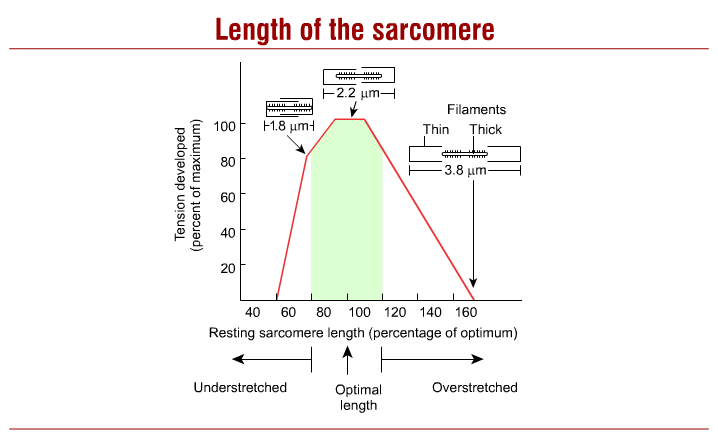
The length of the sarcomere determines the degree of overlap between the thick and thin filaments, and therefore the number of crossbridges formed. The optimal muscle fiber length has the greatest number of crossbridges and therefore produces the greatest contraction force.
Effect of Stimulation Frequency on Force of Contraction
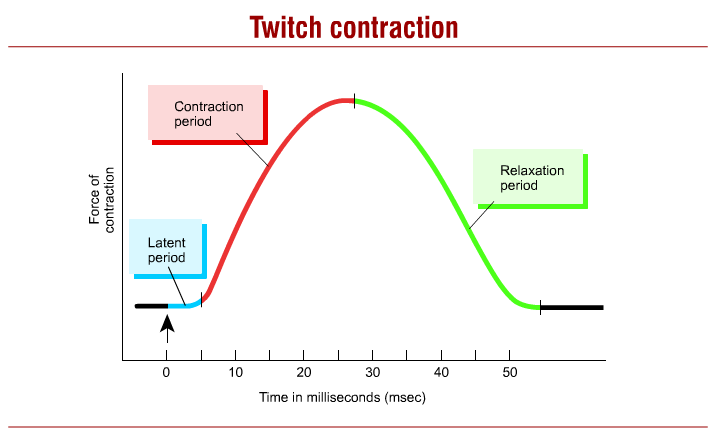
A twitch contraction is the quick shortening observed in a skeletal muscle when a single action potential down a motor neuron stimulates the skeletal muscle fibers within a motor unit to contract. The motor neuron that innervates each motor unit branches so that each skeletal muscle fiber in the motor unit is stimulated to contract simultaneously. The minimal stimulus that results in a muscle twitch is called the threshold stimulus.
The three phases of a twitch contraction are the latent period, the contraction period, and the relaxation period. The latent period is the time between stimulation and force generation. The contraction period is the period during which force is increasing. The contraction force is measured in grams or gram force (gf). The relaxation period is the period when force is decreasing.
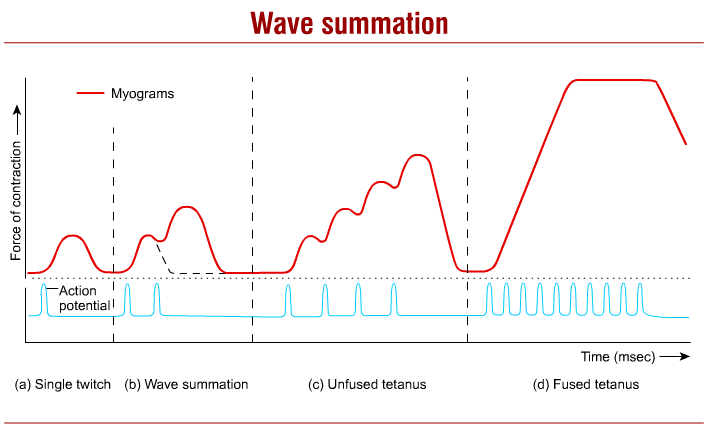
If the contracting muscle is stimulated again before the relaxation phase of a muscle twitch is complete, then the next contraction will produce a greater force or tension. This is called wave summation. Increasing the frequency of muscle stimulation produces sustained force generation. Unfused tetanus occurs when there is a partial relaxation between muscle twitches. Fused tetanus is a sustained contraction with no relaxation observed between twitches. Most sustained voluntary skeletal muscle contractions are unfused tetanic contractions with different motor units stimulated at different times (asynchronous contractions). The asynchronous contractions delay muscle fatigue.
The larger contractile force observed when stimulation frequency is increased is due to elevated intracellular calcium levels. Additional calcium is released from the SR with increasing stimulation frequency, and intracellular calcium released from the SR is not completely returned to the SR between stimuli.
Recording Force of Muscle Contraction
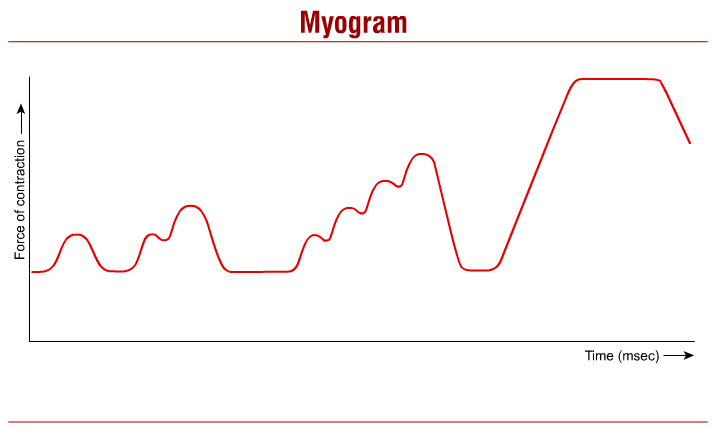
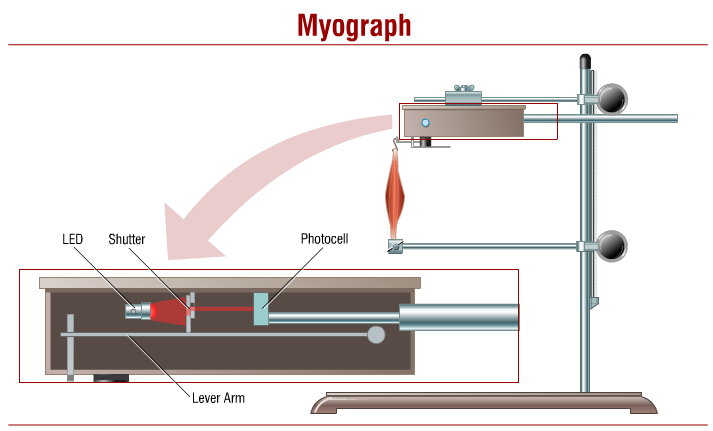
A myograph amplifies and records physiological changes in muscles. Various sensors detect these changes. This equipment gauges the force of contraction, which is measured in units of weight (gram force or gf). Computers are used to record data digitally. A myogram, the visual display of the recorded muscle contraction, can be saved and printed.
- A stimulator stimulates skeletal muscles to contract by either stimulating the nerve, which innervates the muscle, or by stimulating the muscle directly. The stimulus, measured in volts, causes depolarization in either the nerve or muscle fiber. If depolarization reaches threshold, the nerve or muscle fiber will generate an action potential thereby causing a contraction. The minimal voltage that induces an action potential is called the threshold stimulus.
- The transducer converts the contraction force to a directly proportional electrical signal.
- The data acquisition unit (DAC) acquires the electrical signal from the transducer, amplifies it and redirects to the recorder.
- The recorder gets the electric signals that come from the transducer and the DAC to display and record them for further analysis. Computers are used to record data digitally. The visual displays or myograms can be saved and printed.